BEYOND THE NAME – PUBLIC EDUCATION SERIES – EPISODE 52
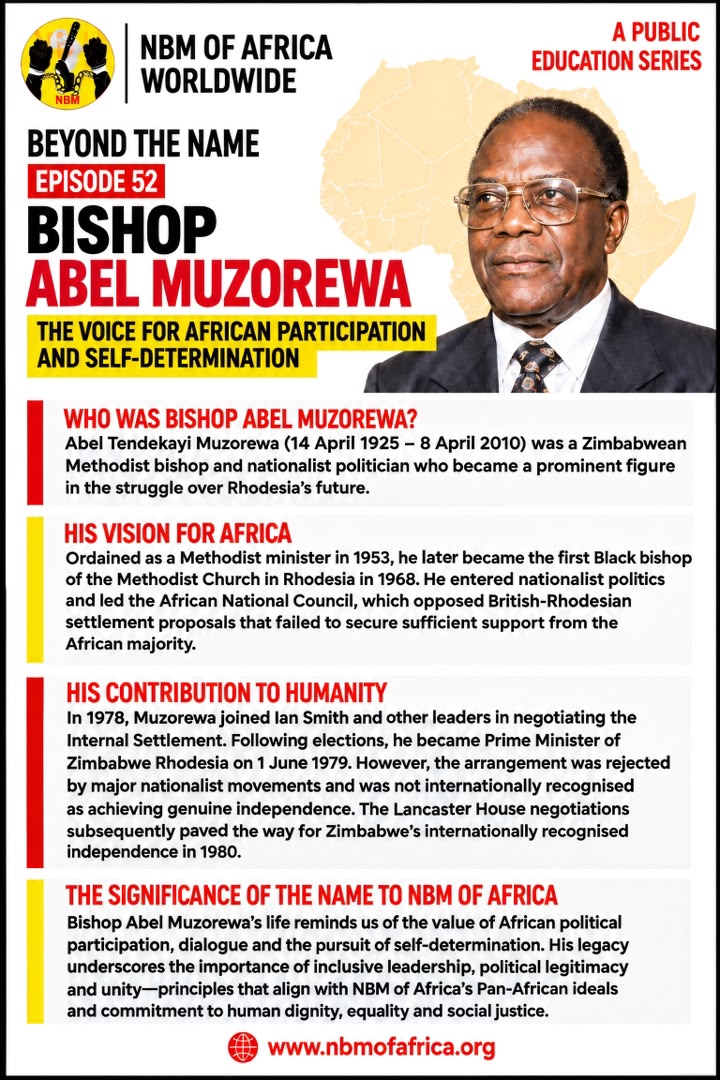
BISHOP ABEL MUZOREWA – THE VOICE FOR AFRICAN PARTICIPATION AND SELF-DETERMINATION
WHO WAS BISHOP ABEL MUZOREWA?
Abel Tendekayi Muzorewa (14 April 1925 – 8 April 2010) was a Zimbabwean Methodist bishop and nationalist politician who became a prominent figure in the struggle over Rhodesia’s future.
Abel Tendekayi Muzorewa (14 April 1925 – 8 April 2010) was a Zimbabwean Methodist bishop and nationalist politician who became a prominent figure in the struggle over Rhodesia’s future.
HIS VISION FOR AFRICA
Ordained as a Methodist minister in 1953, he later became the first Black bishop of the Methodist Church in Rhodesia in 1968. He entered nationalist politics and led the African National Council, which opposed British-Rhodesian settlement proposals that failed to secure sufficient support from the African majority.
Ordained as a Methodist minister in 1953, he later became the first Black bishop of the Methodist Church in Rhodesia in 1968. He entered nationalist politics and led the African National Council, which opposed British-Rhodesian settlement proposals that failed to secure sufficient support from the African majority.
HIS CONTRIBUTION TO HUMANITY
In 1978, Muzorewa joined Ian Smith and other leaders in negotiating the Internal Settlement. Following elections, he became Prime Minister of Zimbabwe Rhodesia on 1 June 1979. However, the arrangement was rejected by major nationalist movements and was not internationally recognised as achieving genuine independence. The Lancaster House negotiations subsequently paved the way for Zimbabwe’s internationally recognised independence in 1980.
In 1978, Muzorewa joined Ian Smith and other leaders in negotiating the Internal Settlement. Following elections, he became Prime Minister of Zimbabwe Rhodesia on 1 June 1979. However, the arrangement was rejected by major nationalist movements and was not internationally recognised as achieving genuine independence. The Lancaster House negotiations subsequently paved the way for Zimbabwe’s internationally recognised independence in 1980.
THE SIGNIFICANCE OF THE NAME TO NBM OF AFRICA
Bishop Abel Muzorewa’s life reminds us of the value of African political participation, dialogue and the pursuit of self-determination. His legacy underscores the importance of inclusive leadership, political legitimacy and unity—principles that align with NBM of Africa’s Pan-African ideals and commitment to human dignity, equality and social justice.
Bishop Abel Muzorewa’s life reminds us of the value of African political participation, dialogue and the pursuit of self-determination. His legacy underscores the importance of inclusive leadership, political legitimacy and unity—principles that align with NBM of Africa’s Pan-African ideals and commitment to human dignity, equality and social justice.