BEYOND THE NAME – PUBLIC EDUCATION SERIES – EPISODE 85
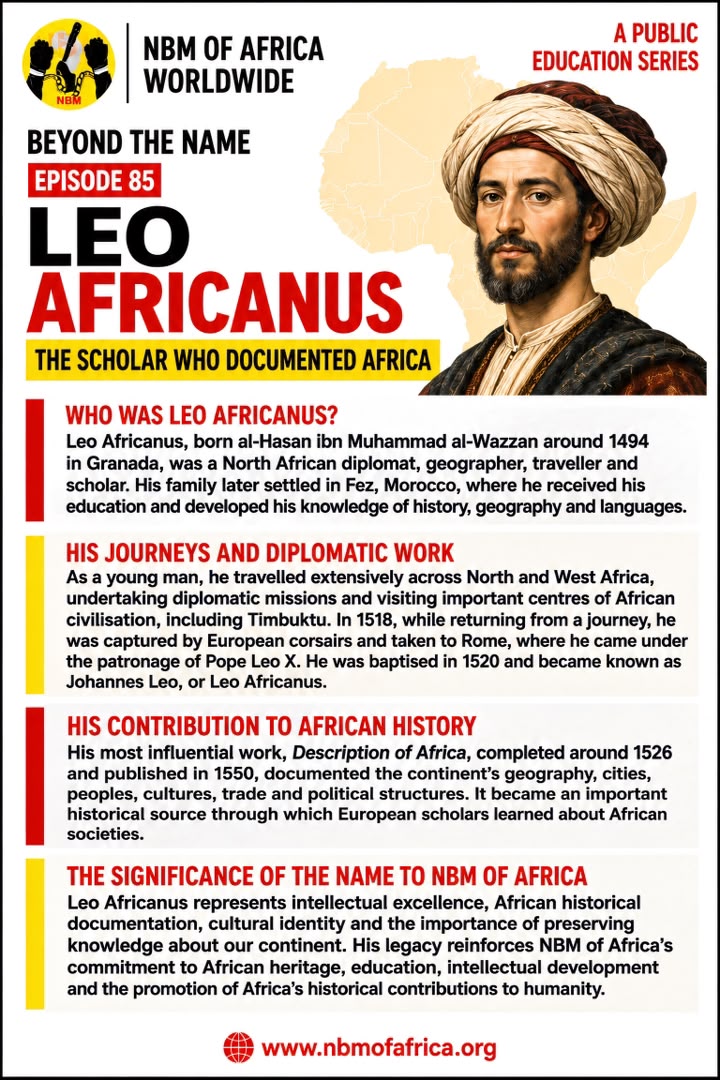
LEO AFRICANUS – THE SCHOLAR WHO DOCUMENTED AFRICA
WHO WAS LEO AFRICANUS?
Leo Africanus, born al-Hasan ibn Muhammad al-Wazzan around 1494 in Granada, was a North African diplomat, geographer, traveller and scholar. His family later settled in Fez, Morocco, where he received his education and developed his knowledge of history, geography and languages.
HIS JOURNEYS AND DIPLOMATIC WORK
As a young man, he travelled extensively across North and West Africa, undertaking diplomatic missions and visiting important centres of African civilisation, including Timbuktu. In 1518, while returning from a journey, he was captured by European corsairs and taken to Rome, where he came under the patronage of Pope Leo X. He was baptised in 1520 and became known as Johannes Leo, or Leo Africanus.
HIS CONTRIBUTION TO AFRICAN HISTORY
His most influential work, Description of Africa, completed around 1526 and published in 1550, documented the continent’s geography, cities, peoples, cultures, trade and political structures. It became an important historical source through which European scholars learned about African societies.
THE SIGNIFICANCE OF THE NAME TO NBM OF AFRICA
Leo Africanus represents intellectual excellence, African historical documentation, cultural identity and the importance of preserving knowledge about our continent. His legacy reinforces NBM of Africa’s commitment to African heritage, education, intellectual development and the promotion of Africa’s historical contributions to humanity.