BEYOND THE NAME – PUBLIC EDUCATION SERIES – EPISODE 53
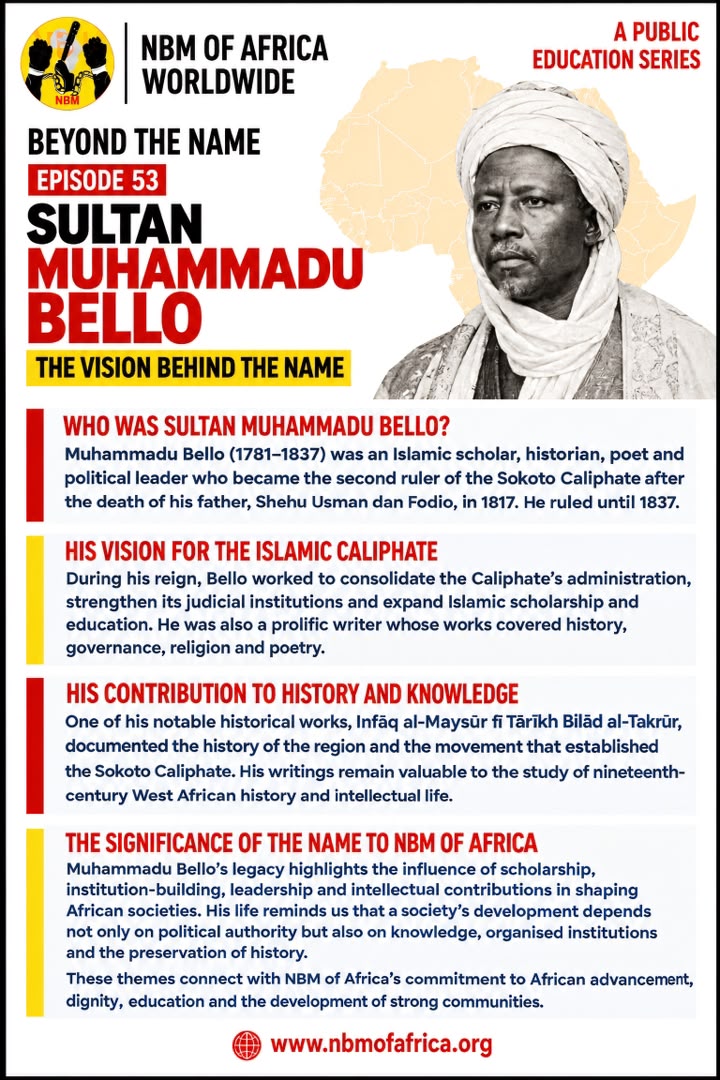
SULTAN MUHAMMADU BELLO – THE VISION BEHIND THE NAME
WHO WAS SULTAN MUHAMMADU BELLO?
Muhammadu Bello (1781–1837) was an Islamic scholar, historian, poet, and political leader who became the second ruler of the Sokoto Caliphate after the death of his father, Shehu Usman dan Fodio, in 1817. He ruled until 1837.
HIS VISION FOR THE ISLAMIC CALIPHATE
During his reign, Bello worked to consolidate the Caliphate’s administration, strengthen its judicial institutions, and expand Islamic scholarship and education. He was also a prolific writer whose works covered history, governance, religion, and poetry.
HIS CONTRIBUTION TO HISTORY AND KNOWLEDGE
One of his notable historical works, Infāq al-Maysūr fī Tārīkh Bilād al-Takrūr, documented the history of the region and the movement that established the Sokoto Caliphate. His writings remain valuable to the study of nineteenth-century West African history and intellectual life.
THE SIGNIFICANCE OF THE NAME TO NBM OF AFRICA
Muhammadu Bello’s legacy highlights the influence of scholarship, institution-building, leadership and intellectual contributions in shaping African societies. His life reminds us that a society’s development depends not only on political authority but also on knowledge, organised institutions and the preservation of history. These themes connect with NBM of Africa’s commitment to African advancement, dignity, education and the development of strong communities.