BEYOND THE NAME – PUBLIC EDUCATION SERIES – EPISODE 86
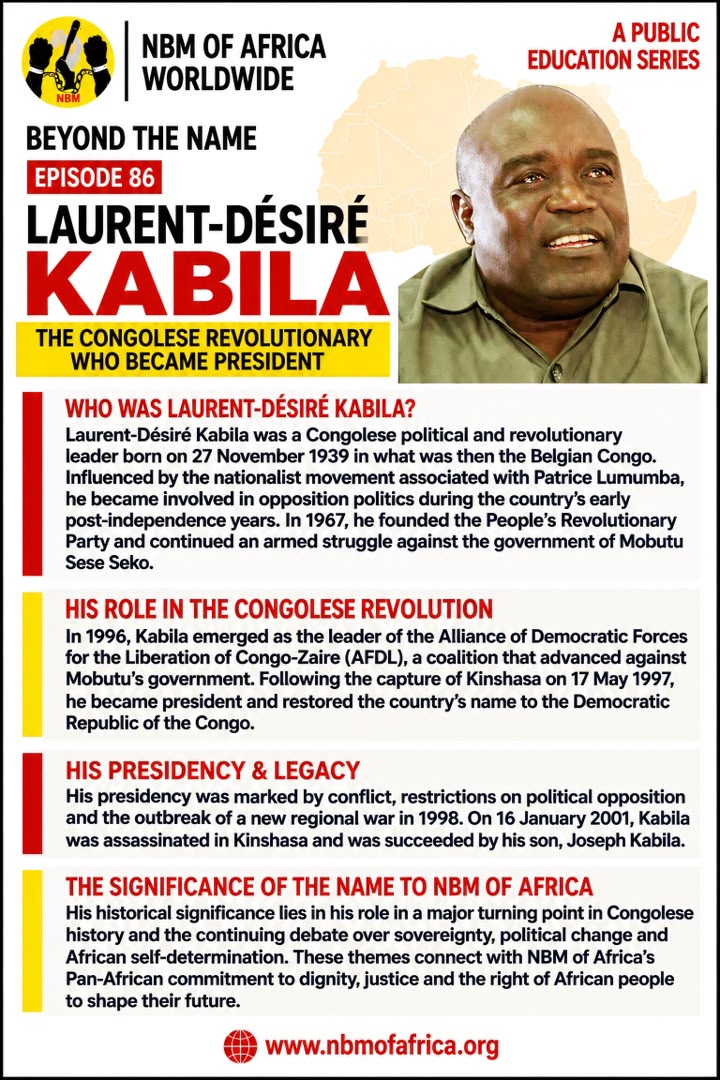
LAURENT-DÉSIRÉ KABILA – THE CONGOLESE REVOLUTIONARY WHO BECAME PRESIDENT
WHO WAS LAURENT-DÉSIRÉ KABILA?
Laurent-Désiré Kabila was a Congolese political and revolutionary leader born on 27 November 1939 in what was then the Belgian Congo. Influenced by the nationalist movement associated with Patrice Lumumba, he became involved in opposition politics during the country’s early post-independence years. In 1967, he founded the People’s Revolutionary Party and continued an armed struggle against the government of Mobutu Sese Seko.
HIS ROLE IN THE CONGOLESE REVOLUTION
In 1996, Kabila emerged as the leader of the Alliance of Democratic Forces for the Liberation of Congo-Zaïre (AFDL), a coalition that advanced against Mobutu’s government. Following the capture of Kinshasa on 17 May 1997, he became president and restored the country’s name to the Democratic Republic of the Congo.
HIS PRESIDENCY & LEGACY
His presidency was marked by conflict, restrictions on political opposition and the outbreak of a new regional war in 1998. On 16 January 2001, Kabila was assassinated in Kinshasa and was succeeded by his son, Joseph Kabila.
THE SIGNIFICANCE OF THE NAME TO NBM OF AFRICA
His historical significance lies in his role in a major turning point in Congolese history and the continuing debate over sovereignty, political change and African self-determination. These themes connect with NBM of Africa’s Pan-African commitment to dignity, justice and the right of African people to shape their future.